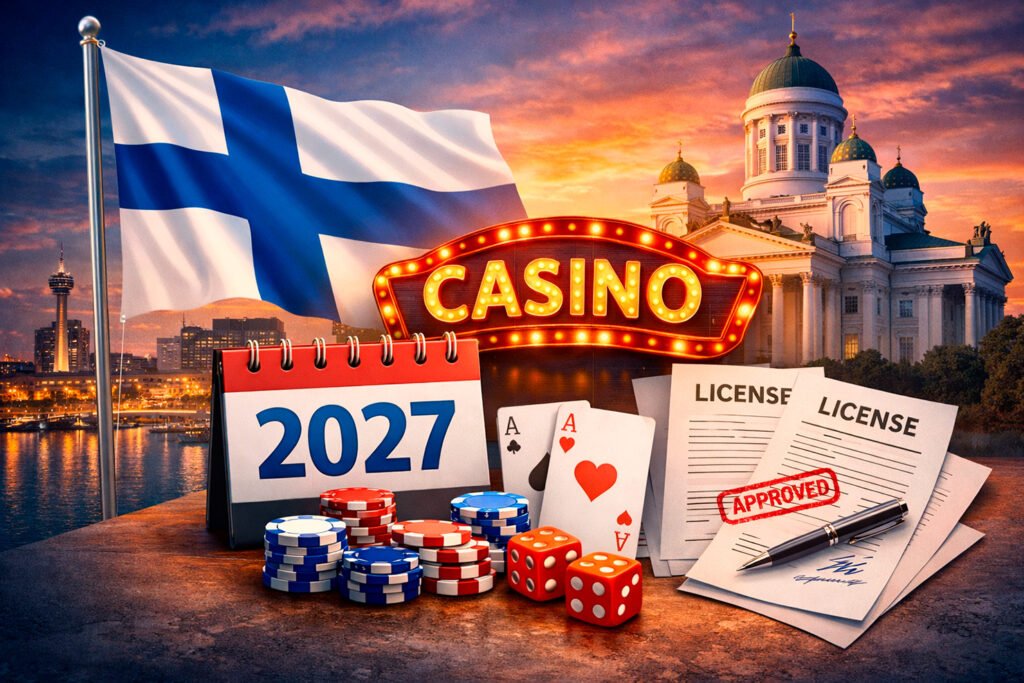
The Nordic iGaming landscape has officially crossed its final historic threshold. With the publication of Finland’s verified list of initial approved gambling licensees in autumn 2026, the Republic of Finland has begun dismantling one of Europe’s last remaining state-run digital gambling monopolies. Operating under the statutory architecture of the modernized Finnish Gambling Act (enacted in January 2026), the National Police Board (Poliisihallitus) has commenced granting formal remote gambling licences ahead of the regulated multi-licence market launch on 1 July 2027.
For decades, state-owned operator Veikkaus Oy held an exclusive statutory monopoly over all gambling activities in mainland Finland. However, rapid digitalization and high consumer demand drove roughly half of Finland’s estimated €1.84 billion annual Gross Gaming Revenue (GGR) toward unlicensed offshore platforms. Following the proven regulatory models of Denmark (liberalized in 2012) and Sweden (liberalized in 2019), Finnish lawmakers enacted a hybrid multi-licensing regime designed to restore channelization, capture tax revenues, and enforce uniform consumer protection standards across all remote operators.
The release of the initial approved licensee register—featuring early recipients such as 711 Finland Limited (RALU/2027/L124), Kimppa Gaming Ltd (RALU/2027/L122), and PulsePlay Gaming Ltd (RALU/2027/L123) alongside major international tier-one applicants—marks a decisive operational milestone. Yet entering the regulated Finnish online casino market is far from a laissez-faire commercial expansion. The Finnish framework pairs a competitive 22% GGR tax rate with some of the strictest product, promotional, and technical compliance mandates in the European Union—including an outright prohibition on welcome bonuses, VIP schemes, and affiliate marketing, alongside mandatory B2B software licensing.
This exhaustive legal, fiscal, and technical review examines the regulatory mechanics of Finland’s 2027 market liberalization, breaks down the verified licensing structure and supervisory transition, analyzes the statutory bans on bonuses and affiliate acquisition, evaluates mandatory technical telemetry and B2B software rules, and establishes an actionable compliance roadmap for online casino operators and suppliers.
SECTION 1: Statutory Architecture and Timeline of Finland’s 2027 Liberalization
Ending the Veikkaus Digital Monopoly
Under the legislative framework signed into law on 16 January 2026, Finland is replacing its monolithic state monopoly with a bifurcated market structure. While Veikkaus Oy retains an exclusive statutory licence over national lotteries, scratch cards, physical slot machines, and land-based casino venues, the lucrative digital verticals—specifically online casino games, RNG slots, online poker, money bingo, and fixed-odds sports betting—are opening to private competition.
Importantly, the law enforces strict structural separation: an entity holding an exclusive-right licence (Veikkaus) cannot simultaneously hold a competitive commercial gambling licence. To compete in the newly liberalized online casino and sportsbook market on equal commercial terms, Veikkaus must ring-fence its digital operations into a separate corporate entity subject to identical regulatory oversight.
| Regulatory Milestone | Statutory Date | Operational & Licensing Impact |
| New Gambling Act Enacted | 16 January 2026 | Establishes statutory basis for partial multi-licence market reform. |
| B2C Licence Application Window Opens | 1 March 2026 | National Police Board begins accepting online casino & betting applications. |
| Initial Approved Licensees Published | Autumn / November 2026 | First verified operators granted conditional 2027 licences following 6-month vetting. |
| Regulated Multi-Licence Market Go-Live | 1 July 2027 | Licensed private operators launch legally; oversight shifts to Finnish Supervisory Agency. |
| B2B Software Licence Applications Open | 1 July 2027 | Game studios, RGS aggregators & PAM vendors submit software licence dossiers. |
| Mandatory B2B Software Supply Rule | 1 July 2028 | B2C licensees legally barred from using unapproved third-party casino software. |
Supervisory Transition: From Poliisihallitus to Lupa- ja valvontavirasto
During the transitional licensing phase throughout 2026 and the first half of 2027, the National Police Board (Poliisihallitus) serves as the primary licensing and vetting authority. Applications—which must be submitted formally in either Finnish or Swedish—undergo a rigorous three-to-six-month statutory review covering corporate governance, ultimate beneficial ownership (UBO) transparency, Anti-Money Laundering (AML) controls, and past compliance history.
On 1 July 2027, regulatory supervision officially transfers to a newly established, dedicated national regulator: the Finnish Supervisory Agency (Lupa- ja valvontavirasto). Equipped with expanded administrative enforcement powers, the new agency will oversee real-time transaction reporting, enforce strict marketing prohibitions, administer ISP and payment-blocking blacklists against unlicensed offshore domains, and levy administrative penalty fees or revoke licences for statutory breaches.
SECTION 2: Licensing Categories, Fee Structures, and Fiscal Calibration
Four Distinct Statutory Licence Classifications
To prevent vertical monopolization and ensure end-to-end supply chain accountability, the Finnish Gambling Act divides regulatory oversight into distinct statutory licences. For international online casino groups, understanding the interplay between B2C operational licences and B2B software authorisations is critical to structuring corporate entities.
| Licensing & Fiscal Parameter | B2C Gambling Licence (Online Casino & Betting) | B2B Gambling Software Licence (Suppliers & Studios) |
| Permitted Commercial Scope | Online slots, table games, live dealer, poker, bingo & sports betting | Development, supply, customization & hosting of gaming software/RGS |
| Non-Refundable Application Fee | €29,000 per primary application (€1,120 for amendments) | Statutory filing fee payable upon application opening (1 July 2027) |
| Licence Validity Term | Up to 5 years (renewable subject to compliance audit) | Up to 5 years (mandatory for all B2C suppliers by 1 July 2028) |
| Annual Supervisory Levy | Tiered by annual GGR: approximately €4,000 to €434,000 | Tiered annual supervisory contribution based on software supply scale |
| Gross Gaming Revenue (GGR) Tax | 22% flat lottery/gaming tax on net GGR (effective 1 July 2027) | Exempt from direct GGR tax (subject to standard corporate taxation) |
| Jurisdictional Eligibility | EEA and non-EEA entities (non-EEA must appoint EEA representative) | Global B2B vendors meeting Finnish technical certification rules |
The 22% GGR Tax Rate and Corporate Structuring
Under the amended Lottery Tax Act (14/2026), Finland established a uniform 22% tax rate on Gross Gaming Revenue (GGR) across all licensed online casino and sports betting verticals starting 1 July 2027 (up from the legacy 12% monopoly rate). Crucially, for Finnish consumers, player winnings generated on locally licensed platforms remain 100% tax-free, whereas winnings derived from unlicensed operators outside the European Economic Area (EEA) remain subject to personal income taxation—creating a powerful fiscal incentive for players to migrate to licensed brands.
Furthermore, unlike jurisdictions that mandate local physical incorporation, Finland permits any company registered within the European Economic Area (EEA)—such as Malta-based holding and operating entities—to apply directly for a Finnish gambling licence. Non-EEA applicants may also apply, provided they appoint an authorized legal representative domiciled within the EEA. Because an existing Malta Gaming Authority (MGA) licence confers zero passporting rights into Finland, holding a direct Finnish B2C licence backed by an efficient EEA operational hub has emerged as the preferred corporate structure among early approved licensees.
SECTION 3: Promotional Prohibitions, Marketing Restrictions, and Affiliate Bans
Dismantling Traditional Player Acquisition Models
The defining hallmark of Finland’s 2027 regulatory regime is its aggressive curtailment of promotional inducements and third-party customer acquisition. Unlike the United Kingdom or Malta—where operators compete heavily through welcome match bonuses, free spin packages, and tiered VIP loyalty rewards—Finland has engineered a framework focused on brand recognition and product quality rather than financial inducements.
| Marketing / Promotional Channel | Statutory Status Under 2027 Act | Compliance Boundary & Enforcement Risk |
| Welcome & Sign-Up Bonuses | Strictly Prohibited | Zero deposit matches, free spins, or sign-up credits allowed for new players. |
| VIP & Tiered Loyalty Schemes | Strictly Prohibited | Bonuses cannot be linked to wagering volume, deposit size, or time spent playing. |
| Retention Bonuses (Existing Users) | Permitted Under Strict Parity | Moderate bonuses allowed only within established relationships on equal terms. |
| Affiliate Marketing & Comparison Sites | Strictly Prohibited | Omitted from closed list of permitted channels (Section 51); triggers licence revocation. |
| Social Media & Influencer Marketing | Banned (Except Own Static Channels) | Paid social ads and influencer partnerships banned; own channels must be non-interactive. |
| TV, Radio & Brand Sponsorships | Permitted (Brand-Only Focus) | Must remain moderate, include 18+ disclaimers, and avoid promoting specific slot odds/games. |
The “Closed List” Marketing Rule and Past-Violation Suitability
Section 51 of the Finnish Gambling Act introduces an uncompromising “closed list” architecture for gambling advertising: any marketing channel or promotional format not explicitly authorized on the statutory list is automatically illegal.
- Total Ban on Affiliates and Influencers: Both affiliate marketing networks and social media influencer campaigns are excluded from the permitted list. Online casino operators entering Finland must terminate all revenue-share or CPA affiliate traffic targeting Finnish IP addresses prior to licence activation.
- Brand vs. Product Separation: While licensed operators may advertise on television, radio, print media, and their own non-interactive social media accounts, advertisements may only promote the operator’s corporate brand identity—promoting specific casino games, slot jackpots, or betting odds is strictly forbidden.
- App Store Distribution: Licensed operators are permitted to publish native real-money casino and sportsbook applications on the Apple App Store and Google Play Store, provided the applications are strictly geo-fenced to mainland Finland and verified against the Finnish Supervisory Agency’s licensee register.
- Suitability Vetting for Prior Black-Market Targeting: During the 2026 licensing evaluations, the National Police Board closely scrutinized applicants’ historical compliance. Operators found to have aggressively targeted Finnish consumers without authorization or violated prior marketing injunctions risked failing the statutory “fit and proper” suitability threshold.
SECTION 4: Mandatory Technical Telemetry, Centralized Self-Exclusion, and Payment Rules
Strong Electronic Identification and Transaction Vaults
To achieve its core public-policy objective of preventing gambling-related harm, Finland mandates deep technical integration between licensed online casino platforms and state supervisory infrastructure.
- Mandatory Strong Identification (18+): Anonymous play is completely eliminated. Every player must undergo mandatory 18+ age verification and strong electronic authentication (such as Finnish bank credentials / Tupas / FTN) prior to depositing funds or launching a game session.
- Centralized National Self-Exclusion Register: Operators must integrate via real-time API with a unified, cross-operator self-exclusion database. A player activating self-exclusion is instantaneously blocked across all licensed platforms operating in Finland.
- Mandatory Loss Caps and Algorithmic Duty of Care: Platforms must enforce customizable deposit and loss limits alongside automated behavioral telemetry engines that monitor session length, loss velocity, and abnormal staking spikes, triggering mandatory proactive interventions.
- Supervisory Transaction Data Reporting: Licence holders are legally required to transmit granular player account and wagering transaction logs to the Finnish Supervisory Agency in a standardized technical reporting format.
Payment Processing Restrictions and Crypto Prohibition
To reinforce market channelization and combat money laundering, the Finnish Gambling Act enforces strict financial rail controls:
- Ban on Cryptocurrency Payments: Unlike Gibraltar’s Prediction Market Regulations 2026—which embrace stablecoin settlement—Finland expressly prohibits cryptocurrencies and digital assets as a payment method on licensed online casino platforms. All deposits and withdrawals must flow through traceable, regulated fiat banking and payment institutions.
- ISP and Payment Blocking Enforcement: Unlicensed offshore operators targeting Finland face aggressive administrative enforcement, including mandatory payment blocking orders enforced across Finnish banks and payment service providers.
To ensure seamless, compliant fiat onboarding and rapid player payouts within Finland’s strict banking environment, platforms operating across regulated European hubs frequently integrate trusted e-wallets and instant banking solutions alongside PayPal casino withdrawals within their Player Account Management (PAM) payment gateways.
SECTION 5: The 2028 B2B Software Licensing Mandate and Game Curation Strategy
Supply Chain Accountability Across Remote Gaming Servers
One of the most consequential provisions of Finland’s regulatory overhaul affects the B2B technology ecosystem. Beginning 1 July 2027, B2B game developers, Remote Gaming Server (RGS) aggregators, and PAM platform providers may submit applications for a dedicated Finnish Gambling Software Licence. One year later—on 1 July 2028—it becomes a direct statutory breach for any B2C licensed operator in Finland to offer games or run platform infrastructure supplied by an unlicensed B2B vendor.
| Product / Technical Layer | Finnish Regulatory Requirement | Strategic Adaptation for 2027–2028 |
| Online Slot Machines (RNG) | Subject to upcoming Ministry decree on game mechanics & speed | Configure RGS engines for localized spin-speed, RTP & loss-limit rules. |
| Live Dealer & Table Games | Fully licensable under B2C Gambling Licence | Deploy Finnish-speaking live dealer tables to differentiate brand quality. |
| B2B Game Studios & Aggregators | Mandatory Finnish B2B Software Licence required by 1 July 2028 | Audit entire RGS vendor roster now; drop non-compliant studios early. |
| Player Account Management (PAM) | Must support centralized self-exclusion & regulator data vaults | Build dedicated Finnish compliance middleware and FTN e-ID connectors. |
Competing Without Bonuses: Product Depth and Studio Quality
Because Finnish regulations outlaw welcome bonuses, VIP programs, and affiliate comparisons, player retention in Finland hinges almost entirely on user experience (UX), instant fiat withdrawals, localized customer support, and superior casino game libraries.
Operators curating high-performing lobbies of online slot machines must prioritize partnerships with tier-one software studios committed to securing Finnish B2B software licences. Integrating proven, mobile-optimized content suites from established developers such as Play’n GO casino software and NetEnt slot machines allows newly licensed Finnish brands to deliver high-engagement gameplay while ensuring full alignment with upcoming Ministry technical decrees.
Furthermore, unlike no deposit casino bonuses commonly utilized in unrestricted international jurisdictions to drive sign-ups, Finnish licensees must channel their commercial budgets into compliant brand sponsorships, seamless mobile app UX, and transparent, equal-terms retention rewards for verified existing customers.
SECTION 6: Operational Roadmap for Launching in Finland’s 2027 Regulated Market
For online casino executives, compliance officers, and B2B technology suppliers preparing for the 1 July 2027 market opening and the subsequent 1 July 2028 B2B software enforcement deadline, executing a disciplined, four-phase operational roadmap is essential.
| Implementation Phase | Core Legal, Technical & Commercial Workstreams | Target Compliance Deliverable |
| Phase 1: Corporate & Vendor Audit (Q4 2026 – Q1 2027) | Finalize EEA corporate structuring; submit remaining B2C dossiers in Finnish/Swedish (€29,000 fee); audit B2B studio commitments. | Approved B2C Gambling Licence & 2028-ready B2B supplier whitelist. |
| Phase 2: PAM & Regulatory Telemetry Build (Q1 – Q2 2027) | Integrate Finnish electronic ID (18+), centralized self-exclusion API, fiat-only payment rails, and automated transaction reporting vaults. | Certified Finnish PAM environment & independent technical security audit. |
| Phase 3: Marketing & CRM Overhaul (Q2 2027) | Decommission all affiliate/influencer links; strip welcome bonuses and VIP tiers; launch brand-only TV/digital campaigns and App Store listings. | Section 51 compliant marketing governance manual & annual reporting workflow. |
| Phase 4: Market Go-Live & B2B Licensing (1 July 2027 – 1 July 2028) | Launch regulated B2C operations under Finnish Supervisory Agency oversight; B2B vendors file software licence applications ahead of July 2028. | Full multi-licence commercial operation & seamless 2028 B2B transition. |
Essential Pre-Launch Compliance Checklist
- Zero-Tolerance Affiliate & Bonus Purge: Verify that all acquisition landing pages, CRM triggers, and third-party tracking links targeting Finland remove welcome bonuses, VIP tiers, and affiliate referral codes prior to 1 July 2027.
- Localized Language & Governance Readiness: Maintain certified Finnish and Swedish legal, customer support, and safer-gambling intervention teams to satisfy ongoing regulatory inspections by Lupa- ja valvontavirasto.
- B2B Supply Chain Lock-In: Secure contractual guarantees from every slot studio, live casino provider, and RGS aggregator that they will apply for a Finnish Gambling Software Licence immediately upon the 1 July 2027 application opening.
Frequently Asked Questions (FAQ)
When does Finland’s regulated online casino market officially launch?
Finland’s competitive multi-licence online gambling market officially launches on 1 July 2027, ending the state monopoly of Veikkaus Oy over online casino games, slots, poker, bingo, and sports betting.
Who are the first approved gambling licensees in Finland?
Following the opening of the application window on 1 March 2026, the National Police Board (Poliisihallitus) published the initial register of approved licensees in autumn 2026, including early recipients such as 711 Finland Limited (RALU/2027/L124), Kimppa Gaming Ltd (RALU/2027/L122), and PulsePlay Gaming Ltd (RALU/2027/L123) alongside major international gaming groups.
What is the GGR tax rate and licence fee for online casinos in Finland?
Licensed online casino and sports betting operators pay a 22% tax on Gross Gaming Revenue (GGR), a one-time non-refundable application fee of €29,000, and an annual supervisory fee scaled by GGR ranging from approximately €4,000 to €434,000. Player winnings from licensed operators are tax-free.
Are welcome bonuses and affiliate marketing allowed in Finland’s 2027 regulated market?
No. Under the Finnish Gambling Act, welcome bonuses, sign-up free spins, VIP loyalty schemes, influencer promotions, and affiliate marketing are strictly prohibited. Operators may only offer moderate, equal-terms bonuses within an established customer relationship and advertise their corporate brand through approved channels.
When do B2B casino software providers need a Finnish licence?
B2B gambling software licence applications open on 1 July 2027, and holding a Finnish B2B software licence becomes mandatory on 1 July 2028. From that date, licensed Finnish online casinos may only use games and platform software supplied by locally licensed B2B providers.
Related Articles
- Gibraltar Hosts Europe’s First Prediction Markets Summit Amid Continental Regulatory Pushback Comprehensive legal, fiscal, and technical analysis of Gibraltar’s Prediction Market Regulations 2026, stablecoin settlement rules, and casino compliance.
- Malta Intervenes at EU Level to Delay Austrian Gambling Reform In-depth review of cross-border European iGaming disputes, EU TRIS standstill extensions, and single-market freedom of service protections.
- UK Remote Casino Operators Recalibrate Product Strategies Following 40% Remote Gaming Duty Impact Exhaustive technical and financial analysis of operator margin recalibrations, RGS game curation, and CRM shifts under elevated UK tax frameworks.