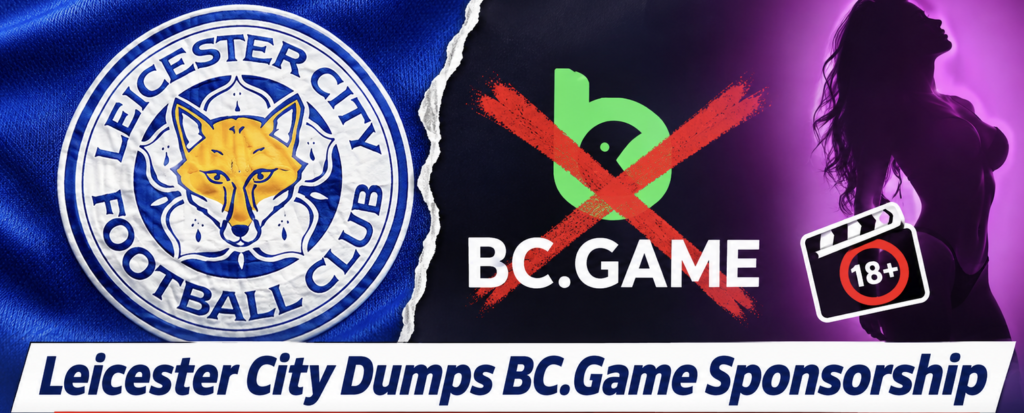
The intersection of English professional football and offshore cryptocurrency gambling reached a decisive breaking point in mid-November 2026. On 18 November 2026, Leicester City Football Club—the 2015–16 Premier League champions currently competing in EFL League One—formally announced the immediate, mutual termination of its front-of-shirt sponsorship agreement with BC Game. Originally signed prior to the 2024–25 campaign and scheduled to run through the conclusion of the 2026–27 season, the multi-million-pound commercial partnership collapsed roughly two-and-a-half years into its term following intense supporter backlash, heightened scrutiny from the Foxes Trust, and longstanding regulatory friction surrounding BC Game’s lack of an active UK Gambling Commission (UKGC) operating licence.
While the immediate catalyst for the split was BC Game’s controversial appointment of adult film performer Eva Elfie as a global brand ambassador—and an associated viral promotional video that drew sharp condemnation from supporter groups—the underlying structural fault lines extend far deeper into the UK’s evolving gambling compliance architecture. BC Game, operated through Belize-registered corporate structures after surrendering its Great Britain white-label operating licence in late 2024, exemplified the high-risk grey-market sponsorship model that British regulators, Parliament, and the Advertising Standards Authority (ASA) have worked aggressively to dismantle throughout 2025 and 2026.
To execute the separation cleanly ahead of their League One fixture away at Huddersfield Town on 21 November 2026, Leicester City confirmed it would field sponsorless matchday shirts while launching an extraordinary enhanced retail returns policy. Supporters who purchased official BC Game-branded replica shirts from 21 October 2026 onward—including personalised and worn garments—were granted until 2 December 2026 to claim full refunds or exchanges, with the club reimbursing standard Royal Mail return postage.
This exhaustive legal, commercial, and technical review dissects the full chronology of the Leicester City and BC Game sponsorship collapse, examines the statutory rules governing unlicensed offshore crypto casinos in British sports marketing, evaluates the due-diligence failures that expose rights holders to reputational and regulatory contagion, and outlines an actionable compliance framework for tier-one operators and commercial sponsors heading into 2027.
SECTION 1: Chronology and Commercial Mechanics of the Sponsorship Collapse
From Premier League Commercial Deal to League One Exit
When Leicester City first unveiled BC Game as its principal front-of-shirt partner ahead of the 2024–25 Premier League season, the agreement reflected a broader wave of cryptocurrency-focused gambling platforms investing heavily in English football visibility to capture global broadcast audiences. At the time of signing, BC Game accessed the British market via a white-label regulatory arrangement. However, within months of the partnership’s launch, the operator’s Great Britain operating licence was surrendered in December 2024 following regulatory and corporate restructuring disputes—leaving Leicester City’s shirts displaying the branding of an offshore operator unauthorized to accept wagers from UK residents.
| Partnership Milestone | Timeline | Commercial & Regulatory Status |
| Initial Front-of-Shirt Agreement Signed | Summer 2024 (Ahead of 2024–25 Season) | Multi-year contract running through end of 2026–27 campaign; valued in multi-million-pound range. |
| UK White-Label Licence Surrender | December 2024 | BC Game ceases holding an active UKGC operating licence; transitions to Belize-registered offshore structure. |
| Sporting Relegations & Governance Pressure | 2024–25 & 2025–26 Seasons | Consecutive relegations from Premier League to Championship and EFL League One amid financial rule scrutiny. |
| Controversial Ambassador Campaign Launch | Early November 2026 | BC Game appoints adult content creator Eva Elfie; viral X campaign generates over 6 million views and fan protests. |
| Immediate Mutual Termination & Kit Recall | 18 November 2026 | Contract terminated immediately; sponsorless shirts adopted; enhanced retail refund window opened through 2 December. |
Financial and Retail Remediation Costs
Terminating a principal shirt sponsorship mid-season imposes substantial direct and indirect financial liabilities on a professional football club, particularly one navigating third-tier EFL revenue constraints and ongoing strategic restructuring:
- Forfeited Sponsorship Receivables: Ending the contract approximately seven months prior to its scheduled expiration in May 2027 eliminates remaining commercial instalment payments for the 2026–27 season, leaving Leicester City with unmonetized front-of-shirt inventory until a compliant replacement partner can be vetted and onboarded.
- Enhanced Retail Merchandising Liability: Unlike standard retail policies that bar returns on customised or worn apparel, Leicester City absorbed the full cost of refunding or exchanging every BC Game-branded shirt sold since 21 October 2026—including shirts printed with player names and numbers—alongside outward and return postal expenses.
- Supply Chain and Kit Re-Manufacturing Friction: Stripping principal sponsor branding mid-campaign requires emergency textile re-production for first-team matchday kits, training wear, stadium perimeter LED boards, and digital media backdrops ahead of immediate league fixtures.
SECTION 2: Regulatory Anatomy of Offshore Crypto Casino Sponsorships in Great Britain
Section 330 of the Gambling Act 2005 and the Unlicensed Advertising Prohibition
To understand why offshore cryptocurrency casinos have repeatedly clashed with British regulatory authorities, compliance officers must examine the statutory architecture of the Gambling Act 2005. Under Section 330 of the Act, it is a criminal offence in Great Britain to advertise foreign gambling—defined as gambling that takes place outside the European Economic Area (EEA) or Gibraltar and is not licensed by the UK Gambling Commission—unless the operator holds an active remote operating licence issued by the UKGC.
Historically, international Bitcoin casinos circumvented direct advertising bans in British sport through two primary commercial mechanisms:
- White-Label Sub-Licensing Arrangements: Overseas platforms contracted with UK-licensed white-label service providers (such as TGP Europe or similar domain-hosting entities) to establish a localized
.co.uklanding page. Even when the localized UK site generated negligible betting turnover, holding a white-label licence permitted the global brand to display its logo across Premier League and EFL shirts, driving international brand awareness in unregulated Asian and Latin American markets. - Geo-Fenced Brand Awareness Sponsorships: When white-label partners surrendered licences or exited Great Britain due to heightened UKGC enforcement, offshore brands argued that displaying a corporate logo on a football shirt constituted passive brand sponsorship rather than an active “invitation to gamble” directed at British consumers—provided British IP addresses were geo-blocked from accessing the offshore
.comcrypto casino.
| Regulatory Dimension | UKGC-Licensed Online Casino | Offshore Crypto Casino (Belize / Curaçao / Anjouan) |
| Statutory Market Access | Authorized to accept bets and market directly to Great Britain residents. | Strictly prohibited from accepting UK players or advertising foreign gambling (s.330). |
| Payment Rails & AML Rules | Fiat-only deposits via regulated banks/e-wallets; credit cards banned; strict KYC/SoF. | Unregulated cryptocurrency deposits (BTC, ETH, USDT); minimal upfront identity checks. |
| Safer Gambling Infrastructure | Mandatory GAMSTOP integration, gross deposit limits & financial risk checks. | Zero GAMSTOP connectivity; no statutory affordability interventions or loss caps. |
| Sports Sponsorship Viability | Permitted subject to IGRG whistle-to-whistle rules & Premier League 2026–27 front-of-shirt code. | Subject to intense UKGC warning notices, club liability risks & severe reputational backlash. |
The UKGC Crackdown on White-Label and Unlicensed Club Partners
Throughout 2025 and 2026, the UK Gambling Commission systematically closed the white-label loophole. Following multimillion-pound regulatory settlements and licence surrenders involving white-label operators that failed to conduct adequate Anti-Money Laundering (AML) and social responsibility due diligence on their overseas brand partners, the UKGC issued formal warning notices directly to British football clubs.
The Commission emphasized that football clubs entering commercial partnerships with operators lacking a UKGC licence risk aiding and abetting unlawful gambling advertising under Section 330 if British consumers can access the offshore platform via simple workarounds, mirror domains, or weak IP geo-blocks. Furthermore, in November 2026, the UK Government confirmed its intention to close residual statutory loopholes to widen ministerial powers over online gambling advertisements, signaling zero tolerance for offshore crypto platforms leveraging British sports equity.
SECTION 3: Brand Governance, Moral Clauses, and Reputational Contagion
How Third-Party Ambassador Campaigns Triggered Termination
While BC Game’s lack of a UKGC licence had drawn criticism from supporter groups such as the Foxes Trust since 2024, the decisive rupture occurred in early November 2026 when BC Game appointed Russian adult film actress Eva Elfie as a brand ambassador and circulated a suggestive promotional video across social media platform X that surpassed six million views.
In a strongly worded public statement, the Foxes Trust articulated the core reputational hazard facing mainstream sports properties partnered with unregulated crypto casinos:
“Both gambling and pornography can have devastating impacts on people’s lives, in particular young people. Partnerships like these bring these two worlds to a larger audience and, by association, link them to Leicester City. Is this who we are now?”
Although Leicester City’s official termination notice framed the exit diplomatically—citing “constructive discussions” and “differing commercial priorities moving forward” without explicitly naming the ambassador controversy—the episode exposes a fundamental structural mismatch between offshore crypto casino marketing tactics and regulated institutional brand governance.
Structural Clash Between Offshore Crypto Marketing and Regulated Standards
Offshore cryptocurrency casinos operate outside the jurisdiction of the UK Advertising Standards Authority (ASA) and the Committees of Advertising Practice (CAP Code). Freed from domestic compliance constraints, offshore platforms frequently rely on shock-value viral stunts, adult-industry crossovers, aggressive influencer giveaways, and high-leverage crypto promotions to capture attention on decentralized social networks.
Conversely, licensed British operators and tier-one sports rights holders operate under strict statutory and self-regulatory codes:
- CAP Code Section 16 (Gambling): Strictly prohibits gambling advertisements from linking wagering with sexual success, seduction, or enhanced attractiveness, and bans any creative content likely to appeal strongly to individuals under 18 years of age.
- Moral Turpitude and Reputational Covenants: Standard commercial sponsorship agreements in English football contain broad morality and brand-protection clauses empowering either party to terminate if the counterparty engages in conduct that brings the club into public disrepute or alienates core community stakeholders.
- Youth Safeguarding and Replica Kit Ethics: Although UK law already prohibits gambling logos on junior replica kits, adult replica shirts worn by players and supporters remain visible across family stands and youth academy broadcasts—making associations with adult-content marketing commercially untenable for heritage football institutions.
SECTION 4: Crypto Casino Regulation in the UK vs. Offshore Jurisdictions
Why Unlicensed Crypto Casinos Cannot Obtain Direct UKGC Licences
A persistent misconception among retail consumers and sports commentators is that offshore crypto casinos simply “choose” not to apply for a UK Gambling Commission licence. In reality, the architectural mechanics of permissionless cryptocurrency gambling are fundamentally incompatible with Great Britain’s statutory licensing requirements, particularly regarding UK casino deposits with cryptocurrencies and strict Source of Funds (SoF) verification across Bitcoin (BTC) currency payment rails.
| Compliance Pillar | UK Gambling Commission (LCCP) Mandate | Offshore Crypto Casino Architecture |
| Source of Funds (SoF) & AML | Mandatory verification of wealth origin; prohibition on anonymous or unhosted wallet funding. | Instant wallet-to-wallet crypto transfers (USDT, BTC, SOL) with minimal upfront KYC. |
| Credit & Borrowed Funds Ban | Strict ban on credit card gambling (since April 2020) and credit-funded e-wallets. | Users can deposit crypto acquired via margin loans, DeFi borrowing, or credit card exchanges. |
| Game Mechanics & Stake Caps | Mandatory £2/£5 online slot stake limits, spin-speed minimums & ban on auto-play/turbo modes. | Uncapped high-volatility crypto slots, instant-crash games & automated rapid betting scripts. |
| Taxation & Statutory Levies | 40% Remote Gaming Duty (RGD) on Gross Gaming Yield + statutory research/treatment levy. | Zero UK tax contribution; nominal annual licence fees in offshore jurisdictions. |
The Commercial Advantage Driving Offshore Crypto Expansion
Because offshore platforms bypass Great Britain’s 40% Remote Gaming Duty, avoid mandatory GAMSTOP self-exclusion blocks, and offer uncapped high-volatility Bitcoin games, they enjoy substantially higher unit economics per active player than regulated UK operators. This regulatory arbitrage enables offshore brands to bid aggressively for global sports sponsorships—often outbidding compliant, tax-paying UKGC licensees whose marketing budgets are compressed by elevated fiscal and compliance costs.
SECTION 5: Strategic Lessons for Licensed Online Casino Operators and Sports Rights Holders
Protecting Market Channelization and Brand Equity
For regulated UK online casino operators, B2B software suppliers, and commercial sponsorship directors, the collapse of the Leicester City–BC Game partnership provides clear strategic lessons heading into 2027:
- Regulatory Pedigree as a Competitive Moat: While offshore crypto casinos can offer short-term sponsorship premiums, they carry severe counterparty default and reputational collapse risk. Tier-one sports clubs, broadcasters, and payment processors—especially those evaluating compliant digital payment architectures like UK casino withdrawals via Bitcoin within regulated fiat-conversion gateways—increasingly recognize that partnering with fully licensed, locally regulated casino brands protects long-term commercial stability and avoids mid-season kit recalls.
- Strict Vetting of Co-Marketing and Ambassador Activations: Even among licensed operators, global brand ambassador contracts must be governed by strict compliance guardrails. Cross-border promotional campaigns executed by an operator’s international division can rapidly spill over onto UK social media feeds, triggering ASA rulings, UKGC licence reviews, and partner terminations.
- Separation of Regulated and Unregulated Corporate Entities: Multi-jurisdictional gaming groups operating across both regulated European markets and international territories must maintain rigorous corporate, domain, and brand separation—ensuring that marketing assets created for offshore markets never reference or associate with UK-facing sponsorships.
SECTION 6: Compliance Due Diligence Roadmap for Sports Sponsorships in 2027
To prevent mid-season commercial failures and regulatory enforcement actions, both iGaming operators and sports rights holders should implement a four-stage compliance due diligence protocol prior to executing sponsorship agreements in 2027.
| Due Diligence Phase | Core Legal & Regulatory Verification Steps | Target Risk Mitigation Outcome |
| Phase 1: Licence & UBO Verification (Weeks 1–2) | Verify active UKGC operating licence status directly on the public register; audit corporate parent & ultimate beneficial owners. | Eliminates Section 330 unlicensed advertising liability & white-label shell risks. |
| Phase 2: Technical Geo-Fencing Audit (Weeks 3–4) | Test IP blocking, VPN detection, payment BIN filtering & mirror domain redirection from Great Britain IP addresses. | Confirms zero unauthorized access by UK residents or underage users. |
| Phase 3: Ambassador & Content Covenants (Weeks 5–6) | Insert explicit CAP Code compliance warranties, ambassador approval rights & adult-content prohibitions into sponsorship contracts. | Prevents third-party influencer stunts from damaging partner brand equity. |
| Phase 4: Continuous Monitoring & Exit Triggers (Ongoing) | Deploy automated social media & regulatory alert monitoring; establish clear termination & merchandising indemnity clauses. | Protects rights holders against retail refund liabilities if regulatory status changes. |
Essential Compliance Checklist for Commercial Partnerships
- Mandatory Merchandising Indemnity Clauses: Sports clubs entering partnerships with gaming or fintech brands should require contractual indemnities covering 100% of replica kit re-manufacturing and supporter refund costs if the sponsor breaches regulatory or morality covenants.
- Pre-Approval of Global Ambassador Campaigns: Sponsorship agreements should grant rights holders advance review rights over any global ambassador or viral campaign that utilizes club marks, colours, or overlapping social media channels.
- Ongoing UKGC Register Monitoring: Legal teams must verify that partner licences remain active throughout the contract lifecycle—triggering automatic suspension rights if a white-label or direct operating licence is surrendered, suspended, or revoked.
Frequently Asked Questions (FAQ)
Why did Leicester City terminate its shirt sponsorship with BC Game in November 2026?
On 18 November 2026, Leicester City mutually terminated its front-of-shirt sponsorship deal with offshore crypto casino BC Game with immediate effect. The termination followed intense backlash from supporters and the Foxes Trust after BC Game appointed adult film performer Eva Elfie as a brand ambassador, alongside ongoing criticism regarding the operator’s lack of a UK Gambling Commission licence.
Is BC Game licensed to operate in the United Kingdom?
No. Although BC Game previously accessed the UK market through a white-label arrangement when the Leicester City partnership began in 2024, it surrendered its Great Britain operating licence in December 2024 and operates as an offshore crypto casino registered in Belize.
What did Leicester City offer fans who bought shirts with the BC Game logo?
Leicester City announced an enhanced returns policy allowing supporters who purchased official BC Game-branded shirts from 21 October 2026 onward—including worn or personalised shirts—to claim a full refund or exchange until 2 December 2026, with the club also reimbursing standard Royal Mail return postage.
Are unlicensed offshore crypto casinos allowed to sponsor British football clubs?
Under Section 330 of the Gambling Act 2005, advertising foreign gambling that is not licensed by the UK Gambling Commission is illegal in Great Britain. The UKGC has formally warned football clubs that partnering with unlicensed offshore operators exposes clubs to legal, regulatory, and reputational risks if British consumers can access the platform.
How does the Leicester City exit impact iGaming sports sponsorships in 2027?
The high-profile collapse reinforces stricter due diligence across English football and European sports, accelerating the shift toward fully licensed, locally regulated casino operators and encouraging clubs to include strict ambassador governance and merchandising indemnity clauses in commercial contracts.
Related Articles
- Crypto Casino UK 2026: Regulatory Rules and Slots Comprehensive breakdown of UK Gambling Commission cryptocurrency payment rules, AML compliance requirements, and regulated slot game frameworks in 2026.
- UK Remote Casino Operators Recalibrate Product Strategies Following 40% Remote Gaming Duty Impact Exhaustive technical and financial analysis of operator margin recalibrations, RGS game curation, and CRM shifts under elevated UK tax frameworks.
- Gibraltar Hosts Europe’s First Prediction Markets Summit Amid Continental Regulatory Pushback Comprehensive legal, fiscal, and technical analysis of Gibraltar’s Prediction Market Regulations 2026, stablecoin settlement rules, and casino compliance.